How fast can you set up sanitation after a disaster?
Speed matters most in the first 48 hours. Passaic sits close to several towns Passaic Porta Pros already services routinely, including Garfield 2.5 miles northeast and Lodi 3.1 miles northeast, so equipment and drivers are rarely far from wherever the emergency is. That proximity is what lets a crew respond to a burst water main or storm surge in Passaic without waiting on a unit to come from across the county. For a widescale event, the standard approach mirrors what's laid out on the emergency porta potty rental page: assess headcount, assess access, then place units where responders and displaced residents can actually reach them. If a shelter or staging area is running without water service, handwashing station rental and portable sink rental units go out alongside the toilets, because OSHA 1926.51(a)(1) requires an adequate supply of potable water in any place of employment, and a relief site staffed by responders counts. Units in the standard porta potty rental line handle most of this work; a deluxe flushable porta potty or an ADA accessible porta potty gets added where the population needs it, since ADA Standards section 213.2 requires that at least 5 percent of clustered single-user units be accessible, never fewer than one.
What sanitation gets deployed for flood, storm or fire response?
Disaster response in Passaic almost never means one type of unit. A washed-out street might need portable restroom rental units for residents, a restroom trailer rental for a command post, and a temporary fence rental around a collapsed structure, all within the same response. Debris cleanup usually calls for a roll-off dumpster rental, and OSHA 1926.252 covers how waste materials and debris chutes need to be handled during that kind of teardown. If flooding has backed up a home's septic system, septic pumping service has to happen before anyone can safely use the plumbing again; a typical residential tank holds around 1,000 gallons and gets pumped every 3 to 5 years under normal conditions, but a flood event can force that timeline up fast. Contaminated wash water from cleanup, especially where crews are dealing with coatings, solvents or pesticides carried in by floodwater, falls under OSHA 1926.51(f)(1), which requires washing facilities specifically for work involving paints, coatings, herbicides or insecticides. Crews also lean on a storage container rental or mobile office trailer rental to secure equipment and supplies on a site that has no working structure left standing. Lighting matters too: OSHA 1926.56(a) sets minimum illumination levels for work areas, which is why a light tower rental often goes out with the sanitation units on nighttime response.
How many portable toilets does a shelter or response site need?
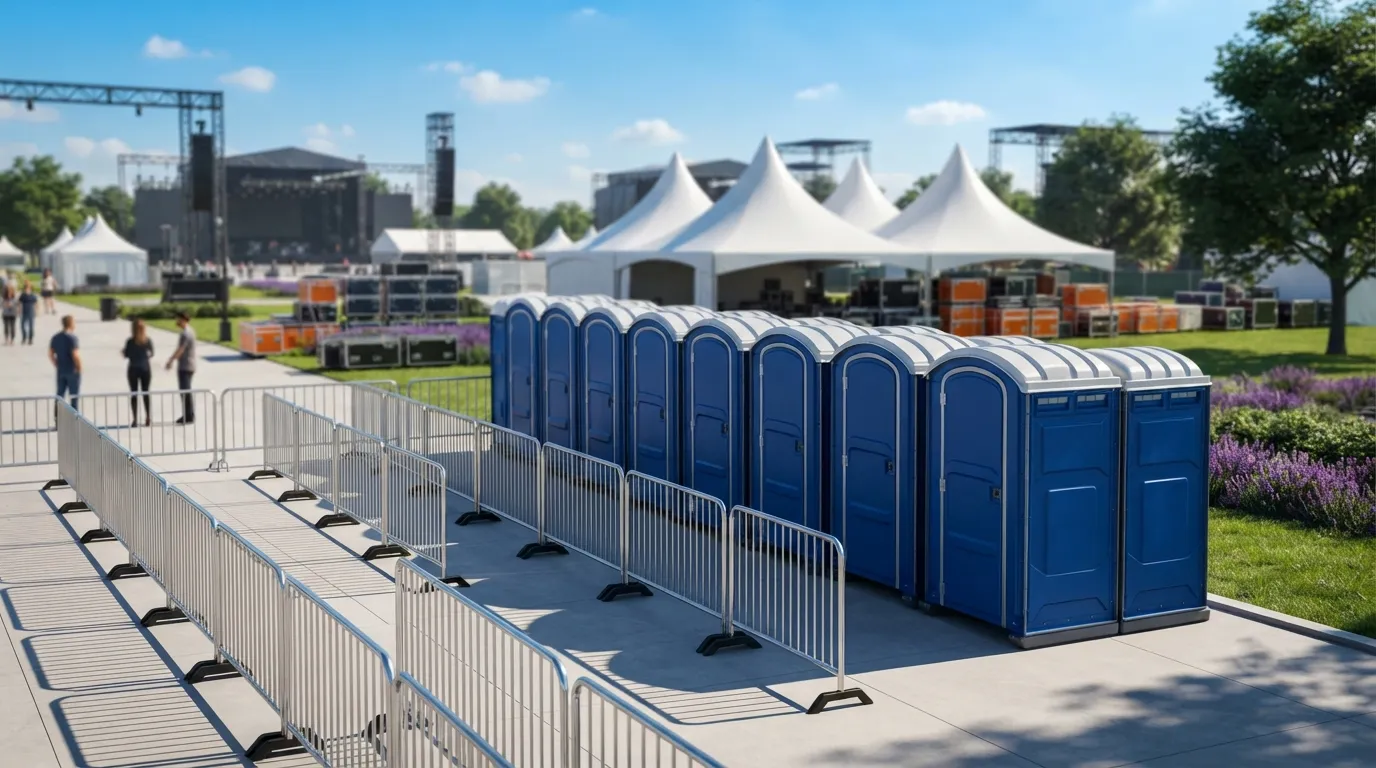
Headcount drives the number, not guesswork. OSHA 1926.51(c) sets the baseline ratio for work crews at one toilet facility for 20 workers or fewer, stepping up to one toilet seat and one urinal per 40 workers as the crew grows past that, and per 50 once a site tops 200 people. A shelter isn't a construction crew, but that ratio is still the closest published guide available, and it's the same math used on the how many porta potties do I need page. Service frequency matters as much as the count: ANSI/PSAI Z4.3 sets a baseline of one service visit per week for up to 10 users across a 40 hour week, though a disaster deployment with round-the-clock use needs servicing far more often than that baseline assumes. Handwashing stations need soap and towels or a hand-drying device under 29 CFR 1910.141(d)(2); hand sanitizer alone doesn't satisfy that standard, which is why hand sanitizer station rental units get paired with real handwashing setups, not swapped in for them. For sites housing displaced residents rather than a labor crew, an event restroom rental unit mix, sized up rather than down, tends to hold up better than a bare-minimum count borrowed from a construction table.
| unit | duration | typical price |
|---|---|---|
| standard | day | $150 |
| standard | week | $200 |
| deluxe | day | $300 |
| ada | day | $230 |
| service_fee | weekend | $700 |
Pricing during an active disaster response tracks close to normal porta potty rental cost ranges, though a weekend surge deployment can carry a service fee similar to the weekend band above. For longer recovery stretches, a monthly porta potty rental rate is usually the better deal than repeated daily billing.
Do you respond to disasters outside Passaic?
Yes. Nutley sits 3.6 miles southwest, Elmwood Park 5.2 miles north, and Lyndhurst 5.5 miles south, all towns Passaic Porta Pros already reaches for routine work, so a regional event doesn't require building a response network from scratch.
Can you deliver without a confirmed street address?
Usually, yes, with a cross street or landmark. Placement still needs to clear about 60 feet of straight clearance for a roll-off delivery truck, and any right-of-way placement should be confirmed with the city first.
What if the site has no power or water?
Units can run without either. A temporary power pole covers lighting and equipment needs, and a handwashing station rental supplies water independent of a working line.
How do you handle contaminated cleanup water?
Washing facilities are required under OSHA 1926.51(f)(1) specifically where workers handle paints, coatings, herbicides or insecticides, which covers a lot of flood and fire cleanup work in Passaic.
Can units stay accessible for residents with disabilities?
Yes. ADA Standards section 403.5.1 calls for a 36 inch clear route, and section 304.3.1 requires a 60 inch turning circle, both built into ADA accessible porta potty placement.
Next step
Get a delivery date
Tell us the address, the dates and the headcount. We size the order and confirm the route.