
How Many Porta Potties Do I Need for a Construction Site?
Start with the OSHA table. Under OSHA 1926.51(c), a crew of 20 workers or fewer needs 1 toilet facility. From 20 workers up to the next bracket, you add 1 toilet seat and 1 urinal per 40 workers. Once you hit 200 workers or more, the ratio eases to 1 toilet seat and 1 urinal per 50 workers. A typical Passaic renovation crew of 12 fits comfortably with a single standard porta potty rental, which runs a 60 to 70 gallon holding tank and stands about 92 inches tall. Bigger jobs, like a multi-building project pulling 45 tradespeople, cross into the next bracket and need two facilities. Do not forget potable water either; OSHA 1926.51(a)(1) requires an adequate supply on every site, regardless of headcount. Pair your toilet count with a handwashing station rental since general sanitation compliance expects both. If your crew is spread across a site larger than a single building footprint, check our porta potty placement guide before locking in a unit count, since travel distance to the nearest toilet matters as much as the ratio itself.
How Many Porta Potties Do I Need for an Event?
Events don't run on OSHA's table, they run on headcount and hours. A wedding reception, a block party, a festival, they all pull different math. Here's a rough planning table for Passaic events:
| headcount | duration | units needed |
|---|---|---|
| 50 guests | 4 hours | 1 to 2 standard |
| 100 guests | 4 hours | 2 to 3 standard |
| 250 guests | 6 hours | 5 to 6 standard |
| 500 guests | 8 hours | 8 to 10 standard, plus 1 ADA |
| 1,000 guests | full day | 15 to 18 standard, plus 2 ADA |
ADA Standards section 213.2 requires that at least 5 percent of clustered units be accessible, with a minimum of one no matter how small the cluster. A backyard wedding restroom rental for 80 guests should plan on 2 standard units minimum, and a festival restroom rental pulling several hundred people needs the full spread, standard plus at least one ADA unit. Check the event restroom rental page for setup timelines if your event runs on a tight load-in window.
Does Alcohol Change the Count?
Yes, plan on roughly 30 to 50 percent more units when alcohol is served. People drink more liquid, use the restroom more often, and lines move slower. A 200 guest wedding with an open bar behaves more like a 280 to 300 guest dry event for restroom math. If your venue expects heavy drinking over 6 or more hours, bump your standard porta potty rental count up a tier and consider a deluxe flushable porta potty or two near the bar area, since deluxe units handle higher traffic better than standard tanks. Multi-day festivals compound this further; each additional day without a full service visit strains tank capacity, so plan servicing around ANSI/PSAI Z4.3, which sets a baseline of one service visit per week for up to 10 users over a 40 hour week as the reference interval, not a fixed rule for high-traffic events.
How Do Multi-Day Rentals Change the Math?
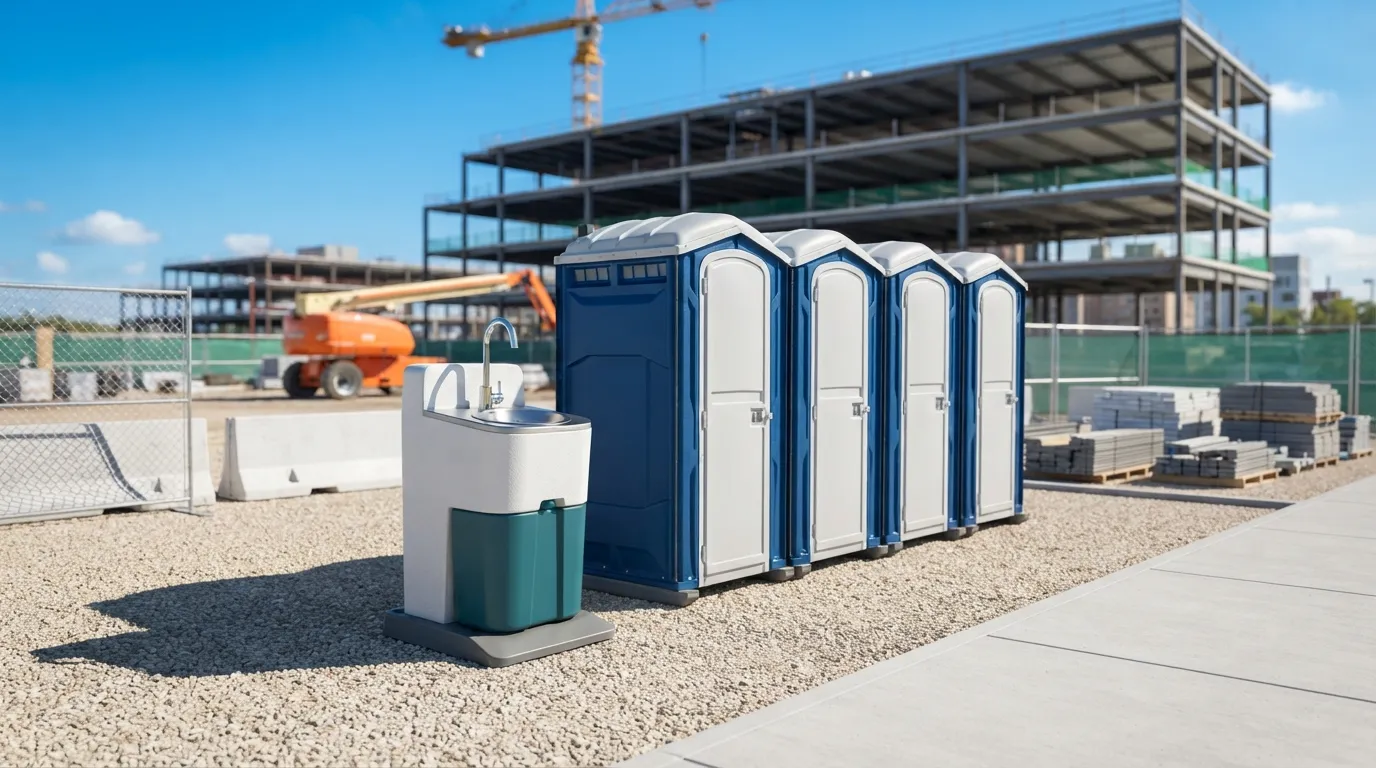
Longer rentals need either more units or more frequent servicing, not necessarily both. A 3-day construction job in Passaic with 15 workers still fits the same OSHA 1926.51(c) bracket as a 1-day job with the same headcount. What changes is tank capacity planning. A 60 to 70 gallon tank fills faster under continuous daily use, so a porta potty rental per day arrangement for a short job might use the same unit that a monthly porta potty rental would service weekly. For events spanning a weekend, like a 2-day county fair, add roughly 20 percent more units over the single-day headcount table to account for the lack of an overnight reset. Check porta potty rental cost for how duration affects total pricing before committing to a multi-day plan.
What About Dumpster Size Alongside Restrooms?
Most construction sites in Passaic ordering portable restroom rental also need debris removal, and dumpster sizing follows its own math. A 10 yard dumpster runs about 12 feet long and holds roughly 1,296 cubic feet, suited to a single room renovation. A 20 yard dumpster runs about 22 feet long, holds around 2,592 cubic feet, and carries roughly 2 to 3 tons depending on debris type. A 30 yard dumpster holds close to 4,000 cubic feet and can carry up to 4 to 5 tons on a mixed construction load. A 40 yard dumpster is about 22 feet long, tops out near 5,184 cubic feet, and handles roughly 5 to 6 tons, while a 10 yard dumpster runs about 12 feet long and holding 1,296 cubic feet. Check dumpster sizes and dimensions for exact footprints, and remember OSHA 1926.252 governs waste disposal chutes and enclosures on active sites. A 30 yard dumpster rental paired with two standard toilets covers most mid-size renovation jobs in Passaic without overordering either service.
How Far Should Units Be Placed From the Work Area?
Close enough that workers actually use them, far enough that servicing trucks can reach the tank without threading through equipment. OSHA 1926.56(a) sets minimum illumination for construction areas, which matters if your units sit in a low-light zone during winter months. A roll-off delivery needs about 60 feet of straight clearance behind the truck, and portable toilet service trucks need similar unobstructed access. On tight Passaic lots, especially rowhouse renovation sites, this clearance requirement often decides where units get placed more than headcount does. If you're servicing a job in Garfield, 2.5 miles northeast of Passaic, or Lodi, 3.1 miles northeast, the same clearance math applies since site density runs similar across these towns. For accessible units, ADA Standards section 403.5.1 requires a minimum 36 inch clear route to the unit, and ADA Standards section 405.2 caps ramp slope at 1:12 if the path isn't level ground.
When Should I Add an ADA Unit?
Add one whenever you expect any guest or worker who might need it, not just when a rule forces your hand. ADA Standards section 213.2 sets the 5 percent minimum for clustered units, but on smaller jobs that math rounds to one unit regardless of your total count. An ADA accessible porta potty needs a 60 inch turning circle per ADA Standards section 304.3.1 and a door opening of at least 32 inches under ADA Standards section 404.2.3. For a Passaic street fair or a golf tournament, budget one ADA unit per cluster location, not one per every 50 guests like standard units. Weekly ADA rentals run in a lower band than daily rates scaled up, so a multi-day event often saves by renting weekly instead of day by day. See ADA accessible porta potty for full spec details before finalizing a headcount-based order.
Worked Example: Passaic Renovation Job
A contractor renovating a 3-unit apartment building in Passaic with a crew of 14 workers over 6 weeks needs 1 standard unit under OSHA 1926.51(c), since the crew sits under the 20-worker bracket. They pair it with a 10 yard dumpster rental for the first two weeks of demo, holding roughly 1,296 cubic feet, then swap up to a 20 yard dumpster rental once framing debris increases. Weekly service on the toilet follows the ANSI/PSAI Z4.3 baseline interval. If the crew later needs a wash-down after applying exterior coatings, OSHA 1926.51(f)(1) requires washing facilities specifically for that paint and coating work, separate from the general toilet requirement. Total setup: 1 standard toilet, 1 handwashing station, and a dumpster sized to the demo phase, delivered by Passaic Porta Pros with roughly a week of lead time built in.
How many porta potties do I need for 100 people?
Plan on 2 to 3 standard units for a 4 hour event with 100 guests. Add an ADA unit per ADA Standards section 213.2, and bump the count if alcohol is served or the event runs past 6 hours.
How many tons can a 30 yard dumpster hold?
A 30 yard dumpster typically carries up to 4 to 5 tons, depending on debris weight. Concrete and shingles fill weight limits fast; check dumpster weight limits before loading mixed heavy debris.
How many cubic feet in a 20 yard dumpster?
A 20 yard dumpster holds around 2,592 cubic feet and runs about 22 feet long, and it typically carries roughly 2 to 3 tons depending on debris type. See dumpster sizes and dimensions for full footprint and height specs.
How many cubic feet in a 10 yard dumpster?
A 10 yard dumpster holds roughly 1,296 cubic feet and runs about 12 feet long, which is why it suits a single room renovation. Pair it with a shorter rental window since smaller loads fill and finish faster; see dumpster sizes and dimensions for the full footprint.
How many feet is a 10 yard dumpster?
A 10 yard dumpster runs about 12 feet long, which fits tighter Passaic lots where a full-size roll-off truck cannot maneuver. Check dumpster sizes and dimensions for width and height too.
How many tons does a 40 yard dumpster hold?
A 40 yard dumpster handles roughly 5 to 6 tons, the highest capacity in the standard lineup. Heavy debris like concrete or shingles hits weight limits before the bin fills visually, so check dumpster weight limits first.
How many tons does a 20 yard dumpster hold?
A 20 yard dumpster carries roughly 2 to 3 tons depending on debris type, enough for most single-family renovation demo. See 20 yard dumpster rental for delivery specifics in Passaic.
How many cubic feet in a 40 yard dumpster?
A 40 yard dumpster holds close to 5,184 cubic feet, roughly four times the volume of a 10 yard bin. Confirm exact dimensions on dumpster sizes and dimensions before booking.
What is the OSHA ratio for toilets on a job site?
Under OSHA 1926.51(c), sites with 20 workers or fewer need 1 toilet. Above 20, add 1 toilet and 1 urinal per 40 workers, easing to per 50 at 200 or more workers.
Do I need more porta potties if I serve alcohol at my event?
Yes, plan on roughly 30 to 50 percent more units. Alcohol increases restroom frequency and slows line turnover, so a 200 guest event with a bar needs closer to 280 to 300 guest capacity.
How many feet is a 40 yard dumpster?
A 40 yard dumpster runs roughly 22 feet long but stands taller than smaller sizes, holding close to 5,184 cubic feet. Confirm exact dimensions on dumpster sizes and dimensions before booking delivery in Passaic.
Next step
Get a delivery date
Tell us the address, the dates and the headcount. We size the order and confirm the route.